

1977 No Mint Mark Penny: No Letter, No Drama?
Establishing a standard designation for Philadelphia Mint products, the absence of a letter under the date on a 1977 one-cent coin served its intended purpose.
Decades of excluding the "P" mark for Lincoln cents persisted as a tradition, creating a specific identification system for researchers.
Supplying the bulk of the money supply on the East Coast of the United States remained the primary goal for coins minted in Philadelphia.
Utilizing a bronze alloy consisting of 95% copper, and 5% zinc, and tin, the 1977 production cycle followed established metallurgical protocols.
Mass measurements for a standard specimen without a mint mark amount to 3.11 grams.
Direct correlation exists between the 1977 penny value no mint mark and its color category or degree of preservation.
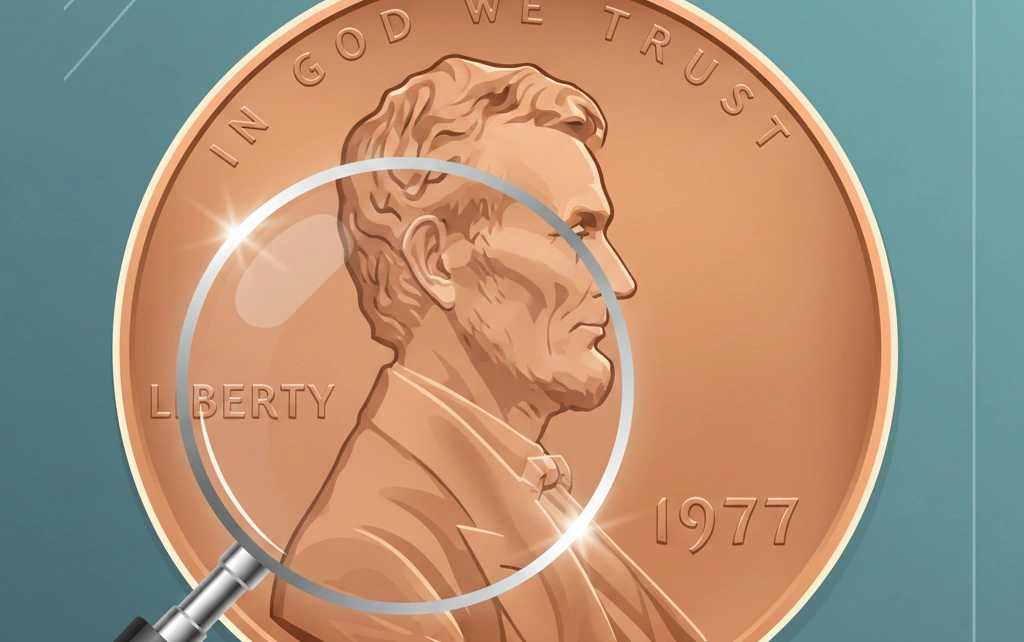
Fixing the coin's diameter at 19.05 mm required the use of a plain edge during the blanking process.
Rapid wear of working dies resulted from high minting intensity, directly affecting the clarity of fine design details.
Mintage Statistics and Population Reports
Production figures for 1977 coins without a mint mark reached a total of 4,469,930,000 specimens.
Surpassing the output in Denver (4,195,939,100 pieces) and San Francisco (3,251,152 pieces), this figure represents the highest volume for the year.
High survival rates for coins remaining in circulation stem from the massive production volume in Philadelphia.
Below is a table showing the distribution of population data according to PCGS for the Red (RD) condition.
Grade | Certified Population | Rarity |
MS64 RD | > 15,000 | Extremely Common |
MS65 RD | ~ 8,500 | Common |
MS66 RD | ~ 2,100 | Moderately Common |
MS67 RD | 158 | Rare |
MS67+ RD | 12 | Extremely Rare |
MS68 RD | 1 | Unique |
Market Value and Auction Records
Valued at the metal price or having a minimum markup not exceeding 10–20 cents, specimens in conditions below MS65 RD remain common.
A sharply limited supply characterizes the market upon reaching the MS67 grade threshold.
Record for MS68 RD: Sold for 2,640 dollars at Heritage Auctions in 2021, this remains the only known specimen in such condition.
Average Price for MS67+ RD: Recorded sales during 2023 fluctuated within the 650–900 dollar range.
MS67 RD Dynamics: Demonstrating an annual growth of 5.5%, the price in this segment showed steady appreciation between 2018 and 2024.
Transitioning from RD to RB through the loss of original copper luster reduces the market attractiveness of the asset by 75–85%.
Leading grading agencies (PCGS, NGC) provide the necessary certification required for investment-grade coins.
Die Deterioration
Radial lines appearing around the letters and numbers indicate late stages of die operation.
Possessing low value, 1977 coins with pronounced die wear are not categorized as collectible errors.
Off-Center Strikes
Design elements appearing outside the field result from the displacement of the planchet.
Valued at 12–25 dollars, a 15–20% offset for a 1977-P cent remains a documented variety.
Specimens maintaining a full date without a mint mark while having a 50% offset reach a price of 150 dollars.
BIE Errors
Creating the illusion of an extra letter "I", a vertical die crack often appears between the letters "B" and "E" in the word LIBERTY.
Typical for Philadelphia in 1977, this variety appears frequently in uncirculated rolls.
Values for a BIE error in Brilliant Uncirculated condition amount to 5–15 dollars.
Alloy and Storage Condition
Higher degradation resistance characterizes 1977 copper compared to 1982–2024 zinc counterparts.
Unfavorable conditions cause the oxide film forming on the surface to transition from pink to dark brown.
Initiating the patination process, air humidity exceeding 45% irreversibly changes the category from Red to Brown.
Formation of green verdigris results from using plastic holders containing PVC.
Preserving coins in grades above MS66 involves the use of desiccants and inert gases by professional dealers.
Improper storage causes annual population losses of coins in ideal red color amounting to approximately 1.2%.
Identification and Verification
Using measuring instruments remains mandatory for establishing the authenticity and condition of a 1977 coin without a mint mark.
Digital Microscope: Facilitates searching for traces of "D" mint mark removal or alteration of the coin field.
Analytical Scales: Ensures verification of compliance with the 3.11 g standard (tolerance +/- 0.13 g).
Directional Light Source: Aids in identifying microscopic scratches hidden by patina.
Reducing the grade from MS67 to MS65, the presence of small carbon spots acts as a critical devaluing factor.
Copper reacting with sulfur present in packaging paper produces these specific spots.

Technical expertise excludes the possibility of an accidental "P" mark omission since Philadelphia did not use it during that period.
1977-D and 1977-S
Distinctive surface features exist for coins from Philadelphia despite identity in composition.
Higher quality rendering of Lincoln's hair and memorial details often characterizes Denver production.
Possessing a satin luster, Philadelphia cents differ from Denver ones showing a frosty luster.
Surpassing circulation samples in mirrored field depth, Proof coins from San Francisco (1977-S) represent the highest technical standard.
Characteristic | 1977 (P) No Mint Mark | 1977-D Denver | 1977-S Proof |
Minting Quality | Standard | Standard | Highest (Proof) |
Weight (g) | 3.11 | 3.11 | 3.11 |
Mintage (billion) | 4.46 | 4.19 | 0.003 |
Price Record ($) | 2,640 | 1,980 | 432 |
Market Cycles and Liquidity Forecast
Uneven distribution characterizes the liquidity for 1977 coins without a mint mark.
Unlimited supply for specimens in MS63–MS65 condition makes realization at prices above face value difficult.
Matching inflation expectations at 2–3% per year, the MS66 RD segment demonstrates relative stability.
Exhaustion of unopened bank roll supplies suggests a 2025–2030 forecast for the MS67+ RD category assuming 6% annual growth.
Finding 85% of top 1977-P specimens in official Mint Sets remains a documented statistical fact.
Increasing the certified population, the gradual opening of these sets simultaneously reduces the number of potentially ideal raw coins.
Influence of 1977 Mint Sets
Serving as the primary source of investment material, official Uncirculated Mint Sets were issued in a quantity of 2,006,128 pieces.
Protection from direct mechanical impact exists for coins in these sets, though they remain subject to gas exposure.
Copper reacting with the packaging cardboard frequently causes the appearance of rainbow toning.
Selling at a 100–300% markup to the base grade price, specimens with attractive toning remain in high demand.
Dullness or the presence of milk spots reduces the coin's chances of obtaining a high evaluation.
Sheldon Scale
Classifying 1977 cents involves the application of strict evaluation criteria.
MS63: Noticeable contact marks appearing in main zones (portrait, memorial) define this grade.
MS65: Retention of full luster with minimal damage characterizes this investment-starting level.
MS67: Almost total absence of defects under 5x magnification serves as the requirement for this tier.
MS68: Flawless surfaces under 10x magnification accompanied by exceptional luster define this unique grade.
Automatically falling into EF–AU categories, most coins from circulation have a value of no more than 2–5 cents.
Estimating the technical probability of finding an MS67 in circulation at 1 in 10,000,000 highlights its rarity.
Conclusion
Originating from Philadelphia, the absence of a mint mark on a 1977 cent does not represent an error.
Confirmed by PCGS/NGC certificates, the investment value of these coins is concentrated exclusively in the upper limits of preservation.
Low survival percentages of red coins ensure the stability of market prices for rare grades.
Objective assessment of numismatic assets in the 1977-P segment relies on utilizing the presented data.
Growth potential for certified specimens of the highest category remains proven by confirmed auction records.